


A whole-body approach to skin, aging, and the daily practice of care
For much of my career as an esthetician, I have been interested in a question that extends far beyond skincare:
What does it actually mean to care for a body over a lifetime?
Nearly 17 years of working with skin has taught me that what we see on the surface rarely begins and ends there. Skin exists within a body influenced by the nervous system, cellular health, connective tissue, fluid movement, nutrition, environment, hormones, sleep, stress, movement, and the countless experiences of being human.
This understanding became the foundation of the OE Method and the Five Pillars I work with as a practitioner.
But what happens when you leave the treatment room?
That question led me to the Principles of Tending.
If the Five Pillars are the physiology beneath my work as a practitioner, the Principles of Tending are my philosophy for caring for yourself at home. They are not a seven-step skincare routine. They are seven ways of thinking about—and being in relationship with—the body you live in.
Because I don't want you to be dependent on a facial to experience your body differently.
I want you to experience what it feels like to slow down. To feel tension soften beneath intentional touch. To notice fluid begin to move. To recognize the difference between skin that needs more and skin asking for less. To experience care rather than correction.
Then, I want you to take that knowing home.
First we experience. Then we recognize. Eventually, we learn to recreate.
That is the practice of tending.
01 — Regulate the nervous system
Before creating change, we create space.
We live in a world that asks an extraordinary amount of our nervous systems.
We move quickly. We consume enormous amounts of information. We work, care for people, make decisions, travel, scroll, respond, perform, plan, and move from one demand to another—often without realizing how much tension we are carrying.
Being a human today is hard.
So the first Principle of Tending is not do more. It is be kind to yourself.
Stress is not only something we experience emotionally. It has a physical expression. The jaw tightens, the shoulders rise, the brow contracts, breathing can become shallower, and muscles brace.
The sympathetic nervous system is an essential survival system; we don't want to eliminate it. But when stress becomes persistent, the body continually adapts to those demands, and processes associated with rest, digestion, recovery, and repair become affected.
This is why nervous-system regulation comes first in my treatments and in home care.
Before lymphatic drainage. Before sculpting. Before devices.
Create spaciousness.
That might mean taking several slow, intentional breaths before beginning your skincare routine. Extending the exhale. Meditating for five minutes. Humming or singing. Gently working around the ears. Going outside. Putting your feet on grass. Walking without your phone. Placing your hands on your body and simply noticing what you feel.
The goal isn't to achieve some perfectly regulated state.
It is to become familiar enough with yourself that you begin to recognize when you are contracting—and learn what helps you soften again.
You don't have to perform calm. You can practice creating the conditions for it.
02 — Support cellular energy
Healthy skin requires energy because living tissue requires energy.
Every cell in the body needs energy to carry out its work. Cellular energy metabolism underlies processes involved in maintenance, signaling, protein synthesis, transport, and repair.
This is one reason my approach to skin has moved progressively deeper over the course of my career.
Topical skincare matters enormously, but skincare cannot replace the basic conditions required by the organism underneath it.
At home, cellular support starts with remarkably unglamorous things: water, nourishment, movement, sleep, light, and recovery.
Hydration matters, as do the electrolytes and minerals involved in normal cellular physiology. A varied, nutrient-dense diet supplies the amino acids, essential fatty acids, vitamins, minerals, and antioxidant compounds the body uses to maintain tissue.
Then there are technologies.
Red and near-infrared light, microcurrent, and PEMF can each interact with the body through different mechanisms, which is why I incorporate frequency-based modalities professionally and, when appropriate, recommend certain technologies for home use.
And skincare itself can provide targeted support through well-formulated ingredients such as antioxidants and other compounds involved in protecting skin from oxidative stress.
But this principle isn't an invitation to build an enormous supplement cabinet or buy every new device.
It is almost the opposite.
Support the fundamentals first. Add intervention with discernment.
03 — Touch the body you live in
Touch is not reserved for the treatment room.
One of the things I hope happens during a facial is that you become more aware of your own body.
You notice how much tension you were holding around your mouth. You feel the difference between one side of your face and the other. You realize your scalp is tight. Your shoulders drop. Your breathing changes.
Someone else's hands can help reveal something that was already there.
That creates a felt sense of knowing.
Home care gives you the opportunity to develop that relationship for yourself.
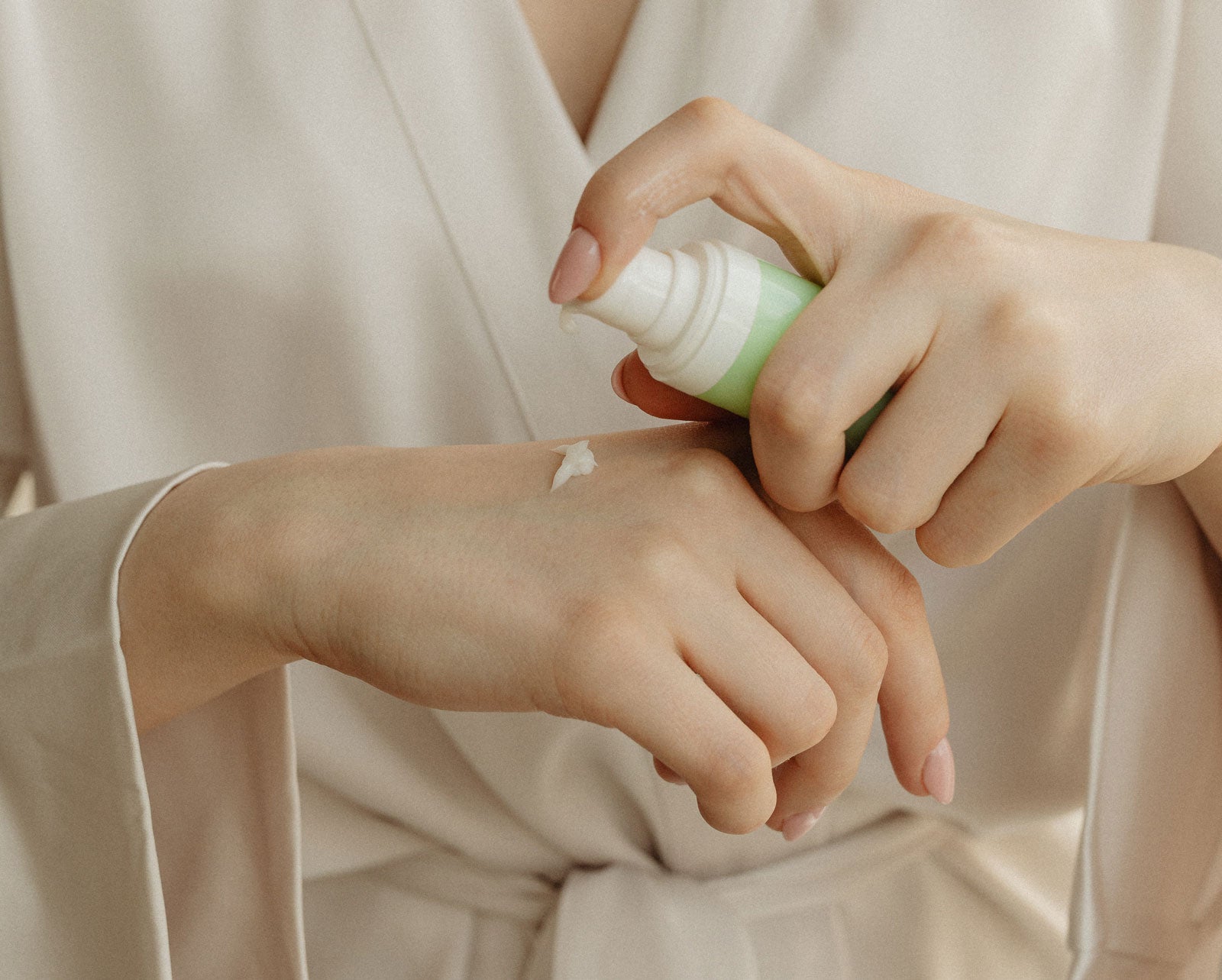
Touch your face when you cleanse it. Massage your body when you apply oil. Place your hands over your chest and abdomen when you breathe. Touch your scalp and your ears. Notice your jaw.
Rather than immediately trying to do something, simply begin by noticing.
What feels warm? Cool? Tender? Tight? Mobile? Restricted? Comfortable? Unfamiliar?
There is something profound about becoming someone whose own body is known to them.
We give an enormous amount of care outward—to partners, children, parents, friends, clients, colleagues, pets, and our communities.
We need to receive care, too. And sometimes we need to be the person giving it to ourselves.
Intentional touch is one way of practicing that.
04 — Care for the tissue beneath the skin
Your face is more than its surface.
Beneath the skin is an interconnected landscape of fascia, connective tissue, muscle, nerves, blood vessels, lymphatic pathways, extracellular matrix, and interstitial fluid.
All of it matters.
This is why my home-care philosophy extends beyond products.
Move your body every day.
Walk. Stretch. Strengthen. Breathe deeply. Move your neck and shoulders. Mobilize the scalp. Stretch the face. Practice gentle lymphatic techniques. Pay attention to habitual tension.
The lymphatic system, unlike the cardiovascular system, does not have a central pump like the heart; lymph movement is supported in part by muscle activity, respiration, and changes in tissue pressure. Movement therefore matters far beyond its visible effects on the body.
Fascia is responsive tissue as well. It exists throughout the body, not just the face—which is why I don't believe facial care should stop at the jawline.
Your posture, neck tension, quality of breath, level of movement, hydration, and nourishment all contribute to the health of your skin.
If we want to care for the skin, we also have to care for the tissue that gives the skin somewhere to live.
05 — Choose products with discernment, not volume
More skincare does not necessarily mean better skincare.
The beauty industry has taught us to equate commitment with complexity: more steps, more actives, more exfoliation, more products layered onto the skin.
I prefer discernment.
For many people, a thoughtful routine can be remarkably simple: cleanse appropriately, provide targeted support (especially hydration), moisturize, and protect the skin from UV exposure. Additional products should earn their place based on the needs of your skin.
I favor thoughtfully formulated products with effective, well-chosen ingredients while always considering the health and integrity of the skin barrier.
The goal isn't to own the most skincare. It is to understand why you are using what you're using.
Does your skin need hydration? Lipid support? Antioxidant protection? Pigment support? A carefully selected active? Or does it actually need you to stop doing so much?
Sometimes the most sophisticated intervention is restraint.
Quality over quantity. Intention over accumulation.
Need help simplifying your routine? My free skincare guide walks you through each step, with product recommendations and guidance to help you build a routine based on intention rather than excess.
06 — Listen to what the skin is communicating
This may be the most important mental shift within the Principles of Tending:
What if the thing you dislike isn't immediately a problem to correct, but information to consider?
Redness. Dryness. Puffiness. Line depth. Sensitivity. Breakouts. Changes in texture.
These observations don't provide a diagnosis by themselves, but they can be data. Something has changed. Instead of immediately attacking the symptom, become curious.
Where am I holding tension in my body? Has my jaw been clenched, my brow contracted, my breath shallow? Am I moving enough to support healthy circulation and fluid movement? Have I been sedentary, traveling, or feeling physically stagnant? What has my emotional landscape been like lately? Have I been living in a sustained state of stress, overwhelm, or contraction? Am I sleeping deeply enough to recover? Am I adequately hydrated and nourished? Am I eating in a way that provides the protein, essential fats, minerals, antioxidants, and other nutrients my body needs to maintain and repair tissue? Does my body feel depleted, inflamed, tense, or simply tired? What has changed—not only in my skincare routine, but in the way I have been living?
None of these observations gives us a diagnosis. They give us context. Observation creates a doorway. Curiosity tends to give us more useful information than criticism.
Use what you see as data, not disappointment.
This is what I mean when I talk about listening to the skin.
Not assuming that every signal has a single meaning—but developing enough awareness to recognize change and respond thoughtfully rather than reflexively.
Use it as data, not disappointment.
07 — Age with the body, not against it
I am not interested in teaching people how to chase youth. I am interested in teaching people how to tend to themselves over a lifetime.
Aging is not something happening only to the face.
We age at every level of the organism. Skin changes. Connective tissue changes. Bone and muscle change. Hormones change. Cellular processes change. Our nervous systems accumulate experience. Our lives change.
So a truly holistic philosophy of aging cannot begin and end with a wrinkle.
It asks bigger questions:
How do I want to feel inside my body?
How do I support strength and mobility?
How do I nourish myself?
How do I recover?
How do I manage stress?
How do I stay connected to other people?
How do I remain curious?
How do I care for my emotional and inner life?
How do I continue inhabiting myself as my body changes?
This is where beauty, for me, becomes something much larger than esthetics.
Physical health matters. Emotional health matters. Connection matters. Meaning matters. Whatever form a spiritual life takes for you may matter.
None exists entirely separately from the others or requires rejecting the desire to look beautiful.
You can love skincare. You can want luminosity, firmness, healthy tissue, and a face that feels vibrant. You can use technology and receive treatments and care about how you look.
The difference is the relationship from which those choices emerge. Are we perpetually correcting a body we believe is failing us? Or are we caring for a body we intend to inhabit for the rest of our lives? I choose the latter.
The goal isn't to fix the body. It is to become someone who knows how to tend to it.
Tending Is a Practice
There is no perfect morning routine that will make you healthy forever. Nor is there a facial that permanently releases every pattern of tension.
There is no serum, supplement, device, meditation, or wellness practice that eliminates the reality of being a human being in a changing body.
That's why I use the word tending. You tend a garden knowing it will continue to change. You water it, feed it, prune when necessary. Pay attention to the season. Notice what is thriving and what needs support. Sometimes you intervene and sometimes you leave it alone. Then you return.
The Principles of Tending ask us to bring that same quality of attention to ourselves.
Regulate the nervous system.
Support cellular energy.
Touch the body you live in.
Care for the tissue beneath the skin.
Choose products with discernment, not volume.
Listen to what the skin is communicating.
Age with the body, not against it.
Not seven more things to perfect. Seven invitations to pay attention.
The goal isn't to fix the body. It is to become someone who knows how to tend to it.